The Arabic Alphabet Is Easier Than You Think
August 9, 2026 · Alumniyat Learning
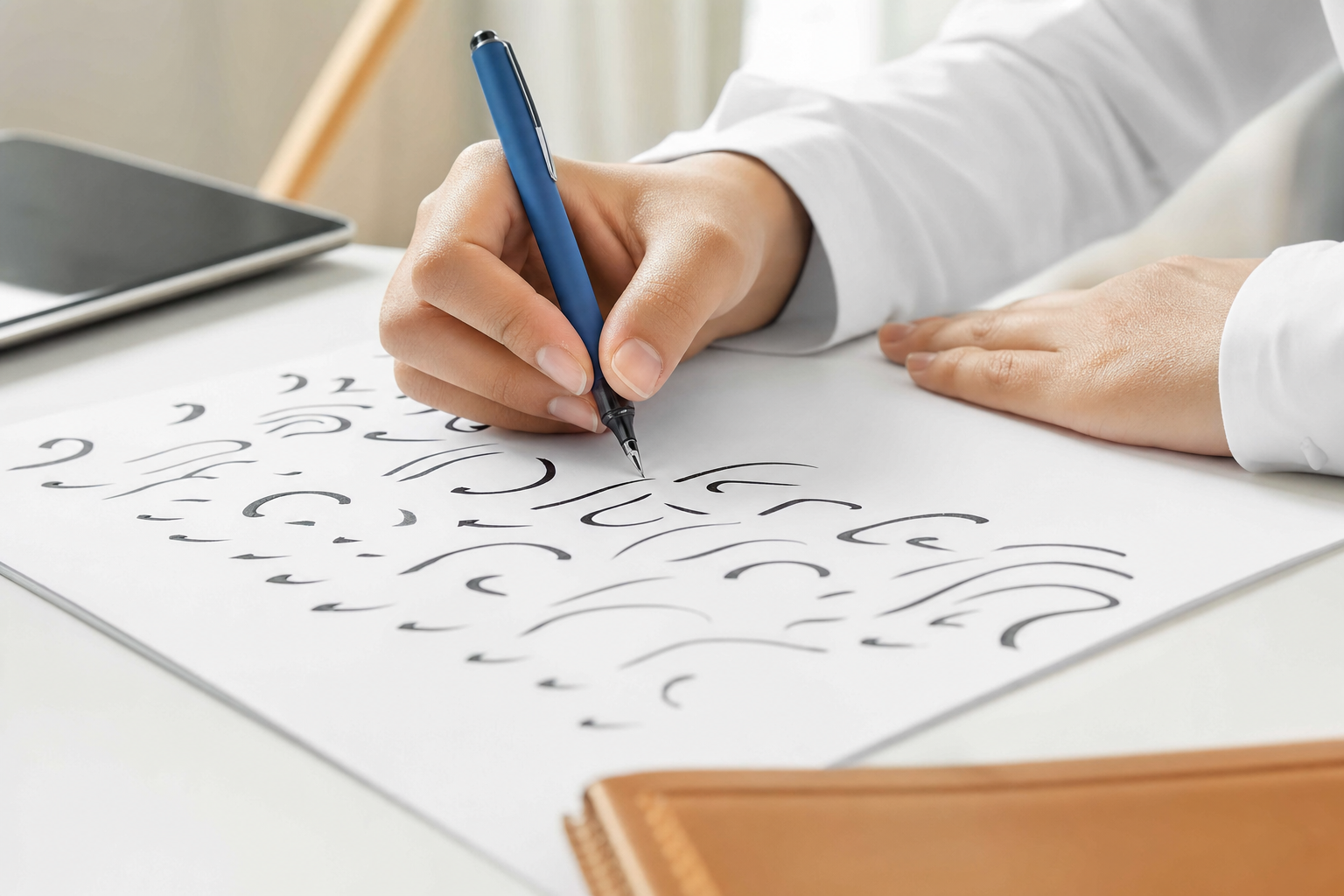
At first glance, Arabic writing can seem like an unbroken line of unfamiliar curves and dots. Many adult learners assume they will need to memorize dozens of complicated symbols before they can read a single word.
The reality is much friendlier. The standard Arabic alphabet is usually taught as 28 basic letters, but those letters are not 28 unrelated drawings. Many share the same underlying shape. Their forms change in predictable ways when they connect, and the vowel system follows a small set of rules.
You do need practice, of course. But you do not need a special talent for languages or beautiful handwriting. You need to understand how the system is organized.
Twenty-Eight Letters, but Fewer Basic Shapes
Arabic letters often come in families. Members of a family share one basic body and are distinguished by dots. Once you recognize the body, learning the related letters becomes much easier.
- ب ت ث are bāʾ, tāʾ, thāʾ. They share a shape, with one dot below, two dots above, or three dots above.
- ج ح خ are jīm, ḥāʾ, khāʾ. One has a dot below, one has no dot, and one has a dot above.
- د ذ are dāl and dhāl. The second adds a dot.
- ر ز are rāʾ and zāy. Again, the second adds a dot.
- س ش are sīn and shīn. Three dots turn the first shape into the second letter.
- ص ض are ṣād and ḍād, another dotless-and-dotted pair.
- ط ظ are ṭāʾ and ẓāʾ.
- ع غ are ʿayn and ghayn. A dot above distinguishes ghayn.
Dots are not optional decoration. They are part of the letter, just as the line in an English capital F distinguishes it from an E. The good news is that one practiced shape often gives you two or three letters at once.
Why Letters Look Different Inside Words
Arabic is a connected script. Most letters join to the letters beside them, so a letter may have an isolated, initial, medial, or final form. These names simply describe whether the letter stands alone, begins a connected section, appears in the middle, or ends it.
Consider the letter ب, bāʾ, which represents the sound b:
- Isolated: ب
- Initial: بـ
- Medial: ـبـ
- Final: ـب
These are not four separate letters. The body and dot remain recognizable; only the connecting strokes change. It is similar to recognizing that printed and handwritten English forms can represent the same letter.
Most Arabic letters follow a small number of positional patterns. Instead of memorizing every form in isolation, practice tracing a letter as it enters and leaves a word. That helps your eye see the stable body beneath the connections.
The Six Connection Breakers
Most letters connect on both sides, but six letters do not connect to the letter that follows them: ا د ذ ر ز و. Because Arabic runs from right to left, this means they do not continue the line toward the left.
They can still receive a connection from the letter before them. They simply create a small break after themselves. These spaces inside a word are normal; they do not mean the word has ended.
Right to Left Is a Habit, Not a Puzzle
Arabic words begin at the right and continue toward the left. At first, your eyes may try to jump back to the familiar English direction. That response fades with regular practice.
Start by placing your finger at the right edge of a short word and moving left one letter at a time. For example:
- باب — bāb — “door”
- كتاب — kitāb — “book”
- نور — nūr — “light”
- سلام — salām — “peace” or “greetings”
Do not try to reverse the word in your head or spell it from left to right. Let the Arabic direction become its own physical reading habit. Short, daily practice is more useful here than one long session each week.
Short and Long Vowels
Arabic treats short and long vowels differently. Understanding that distinction early makes both reading and pronunciation more accurate.
Short Vowels Are Small Marks
The three basic short vowels are usually shown with marks above or below a consonant:
- بَ — ba. The mark is called fatḥah and gives a short a sound.
- بِ — bi. The mark is called kasrah and gives a short i sound.
- بُ — bu. The mark is called ḍammah and gives a short u sound.
Beginning materials often include these marks to guide you. In ordinary Arabic writing, many short-vowel marks are omitted. Readers identify the word through its consonants, pattern, grammar, and context. This may sound intimidating, but learners build that skill gradually rather than all at once.
Long Vowels Use Letters
Long vowels are held longer in pronunciation and are normally represented with letters:
- با — bā, using ا, alif
- بي — bī, using ي, yāʾ
- بو — bū, using و, wāw
Vowel length can distinguish words and forms, so it is worth hearing and practicing from the beginning. Compare كَتَبَ, kataba, “he wrote,” with كاتِب, kātib, “writer.” The long ā in the second word is visible through ا.
A Practical Way to Learn the Alphabet
Avoid trying to memorize all 28 letters in alphabetical order before doing anything else. A more useful sequence is:
- Learn a small family of related shapes.
- Say each letter’s sound while writing it.
- Practice its connected forms.
- Read short combinations with vowels.
- Find the letter inside real words.
- Review older families while adding new ones.
Reading and writing should develop together. Writing slows the shapes down and shows you exactly where letters connect. Reading then teaches you to recognize those same forms without tracing every stroke.
Where Our Basic Foundations Course Begins
Our Basic Foundations course starts exactly here: with the alphabet, sound-to-symbol connections, letter families, positional forms, and the difference between short and long vowels. The goal is not merely to recite letter names. It is to begin reading and writing useful Arabic with a clear understanding of what you see.
The same script supports Modern Standard Arabic, often called Fusha, as well as Egyptian, Syrian, Lebanese, and Gulf Arabic. Pronunciation and everyday vocabulary vary across tracks, but a secure foundation in the writing system remains valuable wherever your Arabic studies lead.
The Arabic alphabet becomes manageable when you stop seeing 28 mysterious drawings and start seeing a small, organized system of shapes, dots, connections, and sounds.
Take it one family and one short word at a time. Before long, the flowing line begins to separate into letters—and those letters begin to carry meaning.
Find your Arabic level in 25 minutes
Take the free placement test and get a learning path built on what you already know.