Egyptian, Syrian, Lebanese, or Gulf: Which Arabic Dialect Fits You?
August 9, 2026 · Alumniyat Learning
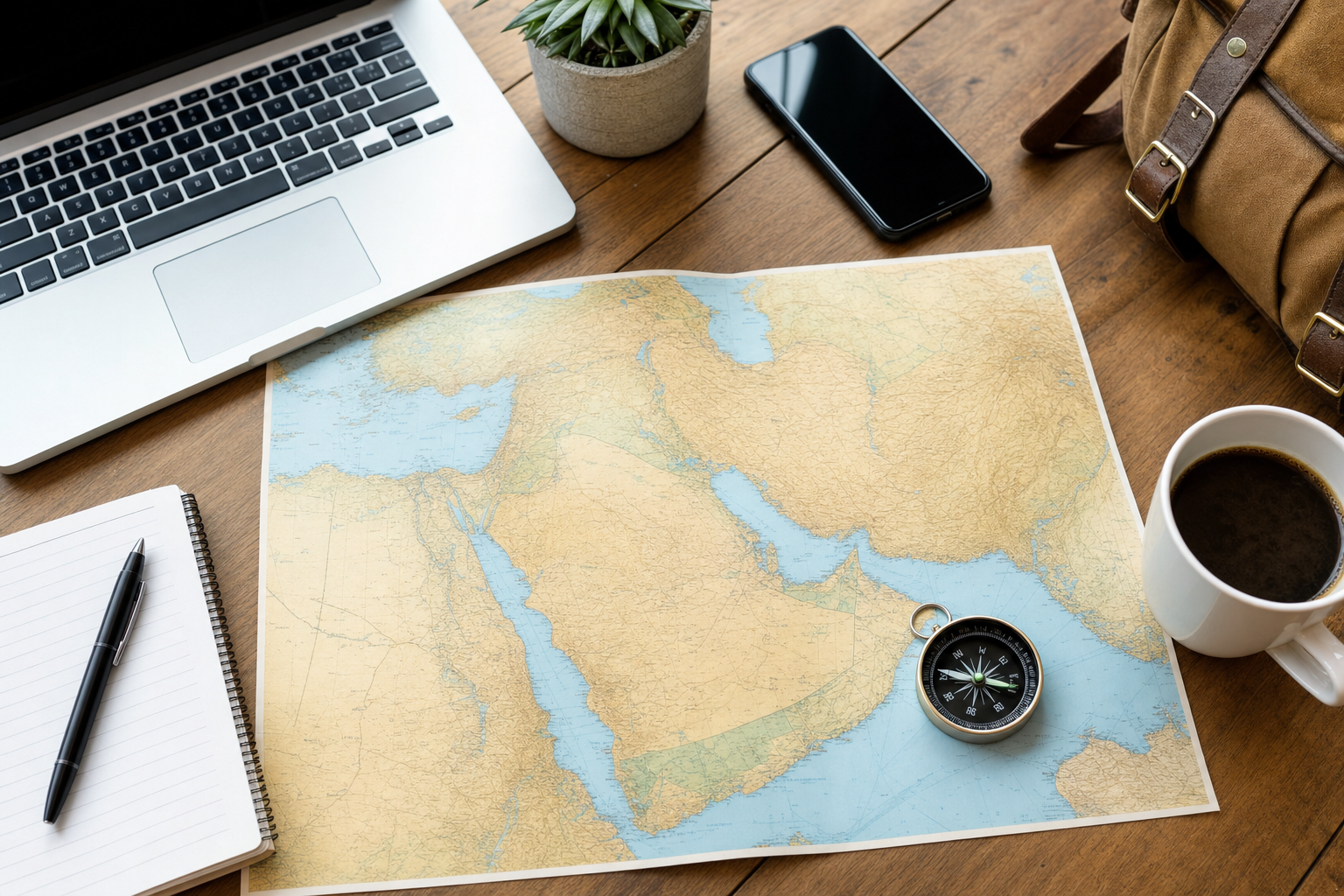
Choosing an Arabic dialect can feel like choosing among several doors into the same house. Egyptian, Syrian, Lebanese, and Gulf Arabic share a great deal, but each has its own pronunciation, everyday vocabulary, rhythms, and cultural associations. The best choice is not necessarily the dialect that seems most popular. It is the one that connects most directly to the people, places, and experiences that matter to you.
At Alumniyat Learning, each dialect is taught as a pure track. We do not blend Egyptian expressions into Syrian lessons or mix Lebanese pronunciation with Gulf vocabulary. You learn a consistent, authentic regional system so that you can speak with confidence instead of wondering which features belong together.
First, What Does Dialect Mean in Arabic?
Modern Standard Arabic, often called Fusha, is the formal variety used across the Arab world in news, books, official communication, and many educational settings. Regional dialects are used for most ordinary conversations: greeting relatives, ordering food, chatting with coworkers, joking with friends, or speaking to a taxi driver.
A dialect is not incorrect Arabic or casual Fusha. It has its own stable patterns. For example, the idea of wanting something may be expressed differently from one region to another. An Egyptian speaker may say عايز قهوة ʿayiz ahwa, meaning “I want coffee,” while many Syrian and Lebanese speakers say بدي قهوة biddi ahwe. In parts of the Gulf, you may hear أبي قهوة abi gahwa.
These varieties remain related, and learning one gives you useful knowledge for understanding others. Still, being understandable is not the same as sounding natural. A focused track helps you develop consistent speech.
Egyptian Arabic
Where it is spoken
Egyptian Arabic is spoken throughout Egypt, with regional variation inside the country. The variety commonly taught to second-language learners is generally associated with Cairo and widely understood urban speech.
Culture and media
Egypt has long been a major center of Arabic-language film, television, theater, music, and comedy. Because Egyptian productions have circulated widely, many Arabic speakers outside Egypt have had substantial exposure to the dialect. That familiarity can make Egyptian easier for some people from other regions to recognize, although it does not guarantee effortless understanding.
A common greeting is إزيك؟ izzayyak? or izzayyik?, meaning “How are you?” Its sounds and vocabulary quickly give Egyptian Arabic a recognizable character.
Egyptian may fit you if:
- You have Egyptian relatives, friends, neighbors, or colleagues.
- You plan to live, study, work, or travel extensively in Egypt.
- You enjoy Egyptian movies, television, music, or comedy.
- You want a dialect with a large body of accessible cultural material.
Syrian Arabic
Where it is spoken
Syrian Arabic refers to the dialects spoken in Syria. Our Syrian track provides a consistent Syrian model rather than mixing features from across the Levant. Syria itself contains regional differences, but learners benefit from first building a dependable core.
Culture and community
Syrian Arabic connects learners with Syrian family life, food traditions, music, television drama, storytelling, and diaspora communities around the world. It belongs to the broader Levantine dialect family, so it shares many features with Lebanese, Palestinian, and Jordanian speech. That closeness helps with comprehension, but the varieties are not interchangeable in every detail.
You may hear شو الأخبار؟ shu al-akhbar?, literally “What is the news?” and used much like “How are things?” The word شو shu, meaning “what,” is common across much of the Levant.
Syrian may fit you if:
- Your family or community has Syrian roots.
- You regularly speak with Syrian friends, clients, students, or coworkers.
- You are interested in Syrian television, music, cooking, or literature.
- You want a Levantine foundation with distinctly Syrian pronunciation and usage.
Lebanese Arabic
Where it is spoken
Lebanese Arabic is spoken in Lebanon and in Lebanese communities abroad. Like every living dialect, it includes differences connected to region, community, and generation. A dedicated Lebanese course keeps the instructional model coherent while preparing you to notice real-world variation.
Culture and media
Lebanese Arabic has strong connections to music, entertainment, publishing, food culture, and a far-reaching diaspora. Learners often choose it because a parent or grandparent spoke Lebanese, because they have a Lebanese partner, or because they regularly visit Lebanon.
A familiar greeting is كيفك؟ kifak? or kifik?, meaning “How are you?” Syrian speakers use this expression too, but pronunciation, intonation, and other everyday choices can signal a Lebanese identity.
Lebanese may fit you if:
- You want to speak with Lebanese relatives or reconnect with family heritage.
- You travel to Lebanon or spend time in Lebanese communities abroad.
- You are drawn to Lebanese music, television, food, or social culture.
- You want Levantine Arabic while maintaining a specifically Lebanese voice.
Gulf Arabic
Where it is spoken
Gulf Arabic is associated with countries along the Arabian Gulf, including Kuwait, Bahrain, Qatar, the United Arab Emirates, eastern Saudi Arabia, and neighboring areas. The region contains meaningful differences in pronunciation and vocabulary. A structured Gulf track gives learners a consistent foundation instead of casually combining forms from several countries.
Work, travel, and regional life
Gulf Arabic is often a practical choice for people working with Gulf-based organizations or living in the region. English is common in many professional environments, but Arabic can transform everyday interactions and help learners build stronger relationships with colleagues, customers, neighbors, and host families.
In parts of the Gulf, you may hear شلونك؟ shlonak? or shlonich?, meaning “How are you?” The exact form varies by location and speaker, which is one reason focused instruction matters.
Gulf may fit you if:
- You live or work in a Gulf country.
- Your clients, colleagues, or business partners are from the region.
- You have Gulf Arab family members or close friends.
- You are interested in the region’s poetry, music, hospitality, and contemporary life.
How Mutually Intelligible Are These Dialects?
Speakers of these dialects can often understand one another, especially when they have previous exposure through media, travel, family, or work. Egyptian Arabic is familiar to many people because of entertainment. Syrian and Lebanese are closely related as Levantine varieties. Gulf Arabic shares the same broader Arabic foundation but may initially sound more distant to Egyptian or Levantine learners.
Mutual intelligibility is never automatic. Speech speed, local slang, age, education, and personal experience all matter. Speakers also adjust their language when talking across regions. They may slow down, choose widely recognized words, or move closer to Fusha.
Your first dialect does not trap you. It gives you a home base from which other varieties become easier to notice and learn.
How to Choose Your Track
- Start with people. If your spouse, grandparents, close friends, or coworkers speak one dialect, choose that dialect. Regular human connection is more valuable than abstract popularity.
- Consider your destination. For extended travel or relocation, learn the local variety. Egyptian serves Egypt; Syrian serves Syrian communities; Lebanese serves Lebanon and its diaspora; Gulf serves communication in Gulf settings.
- Follow your cultural interests. The films, songs, programs, podcasts, and recipes you genuinely enjoy will keep you listening between lessons.
- Think about work realistically. Choose the variety your colleagues or clients actually use. If your work is primarily formal, academic, or pan-Arab, combine dialect study with Fusha rather than expecting one to replace the other.
- Use your existing background. If you already understand some Arabic from home, a placement test can help identify whether you should strengthen that dialect rather than begin a different one.
There Is No Wrong Door
If you have a clear family, travel, or professional connection, let that guide you. If you do not, choose the culture you most want to spend time with. Egyptian offers extensive media and a distinctive conversational style. Syrian and Lebanese provide two closely related but clearly identifiable Levantine paths. Gulf Arabic supports life and relationships across an economically and culturally important region.
Whichever track you choose, consistency matters. Learn its sounds, sentence patterns, and everyday expressions as a complete system. Once that foundation is strong, you can explore neighboring dialects without turning your own speech into an uncertain blend. The goal is not to collect random Arabic phrases. It is to build a real voice that connects you with real people.
Find your Arabic level in 25 minutes
Take the free placement test and get a learning path built on what you already know.